10 Best Mutton Dishes in Rajasthan to Savor from Royal Recipes to Street Food
Rajasthan does not treat mutton as just another meat curry. Here, it carries stories of royal hunting camps, desert survival, festive kitchens, community feasts, and market snacks eaten standing beside a hot kadhai. The best dishes are bold, slow-cooked, and deeply tied to place.
In Rajasthan, “mutton” usually means goat meat, cooked with local chillies, curd, ghee, whole spices, dried ingredients, and patience. Some recipes are fiery enough to wake up the palate. Others are pale, creamy, and rich, made for royal tables. Many sit somewhere in between, shaped by home cooks, travellers, traders, and street vendors.
This guide covers the 10 best mutton dishes in Rajasthan to try across Jaipur, Jodhpur, Udaipur, Bikaner, Ajmer, Kota, and smaller towns. Each one brings a different side of the state to the plate.

Rajasthan’s mutton dishes are shaped by desert kitchens and royal tables
Rajasthani mutton food comes from two strong traditions.
The first is the royal Rajput kitchen, where meat dishes were built around hunting, celebration, hospitality, and status. These recipes often use ghee, curd, nuts, saffron, whole spices, and slow cooking. Dishes like safed maas and maas ke sooley still carry that palace-kitchen identity.
The second is the practical desert kitchen. In arid regions, cooks relied on dried red chillies, dried spices, hardy grains, and minimal water. That is why many mutton dishes here are intense rather than delicate. They are made to pair with bajra roti, missi roti, baati, or plain rice.
The best way to experience them is not only in fine-dining restaurants. Eat at old city eateries, family-run non-veg dhabas, highway kitchens, festival stalls, Ramzan markets, and heritage hotel restaurants. Rajasthan rewards curious eaters.
Royal mutton dishes that define Rajasthani feasting
1. Laal maas is Rajasthan’s most famous fiery mutton curry
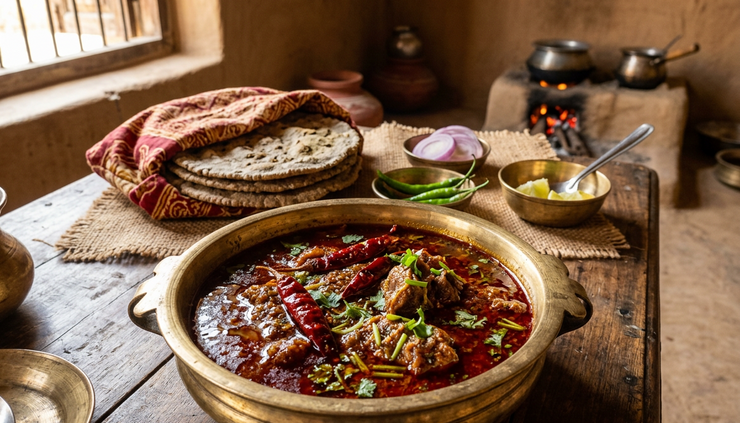
Laal maas is the dish most travellers search for first, and with good reason. It is bold, smoky, red, and unapologetically spicy. The colour traditionally comes from dried red chillies, especially the famous Mathania chillies associated with the Jodhpur region.
The recipe often uses goat meat, curd, garlic, whole spices, ghee, and chillies. What makes it special is the balance between heat and depth. A good laal maas is not just hot. It has a roasted chilli flavour, a rich gravy, and tender meat that pulls apart easily.
Culturally, laal maas is linked with Rajput hunting traditions, where meat could be cooked with a small set of strong ingredients. Today, it is a symbol of Rajasthani non-vegetarian food.
Where to try it
Look for it in Jodhpur, Jaipur, Udaipur, and Bikaner. Heritage hotels often serve polished versions, while local eateries and old non-veg restaurants may offer a sharper, more rustic plate. Pair it with bajra roti or tandoori roti.
2. Safed maas shows the softer side of royal cuisine
If laal maas is fire, safed maas is silk. This creamy mutton dish is made with curd, cream or milk, cashews, almonds, poppy seeds in some versions, and gentle spices. It avoids the red chilli punch and focuses on richness.
The “white” gravy is not bland. It carries warmth from cardamom, cloves, pepper, and sometimes green chillies. The texture is luxurious, and the flavour builds slowly.
Safed maas reflects the refinement of royal kitchens. It shows how Rajasthani cooks could create contrast within meat cookery, from warrior-style chilli dishes to elegant court food.
Where to try it
Udaipur and Jaipur are good places to start, especially in heritage restaurants and traditional Rajasthani dining rooms. It also appears on menus in palace hotels, where chefs often preserve older family recipes.
3. Junglee maas is the campfire dish with a wild spirit
Junglee maas is one of Rajasthan’s most fascinating mutton dishes because of its simplicity. The older style is said to use very few ingredients, often meat, ghee, salt, and dried red chillies. The idea was to cook meat during hunting trips or outdoor journeys without a full pantry.
Modern versions may include garlic, onions, or spices, but the best ones keep the stripped-down character. The result is smoky, spicy, and meat-forward. It tastes like a dish made for cold desert nights and open fires.
Its cultural value lies in its link to the outdoors. It is less about palace polish and more about survival, skill, and appetite.
Where to try it
Ask for it at specialist Rajasthani restaurants in Jaipur, Jodhpur, and Udaipur. Some heritage properties make it on request or include it in traditional meat platters. Local dhabas sometimes serve a similar dry, chilli-heavy mutton preparation, even if they call it by another name.
4. Maas ke sooley brings royal kebabs to the table
Maas ke sooley, sometimes called mutton soola or sooley, is a Rajasthani kebab-style dish. Thin or chunky pieces of mutton are marinated with curd, spices, chilli, and often raw papaya to tenderise the meat. They are then grilled, roasted, or cooked on a tawa.
The appeal lies in the charred edges and juicy centre. Unlike a gravy dish, maas ke sooley lets the marinade do the work. Each bite carries smoke, spice, tang, and the richness of meat.
This dish is closely tied to royal and feasting traditions. Kebabs were ideal for guests, gatherings, and outdoor cooking.
Where to try it
Jodhpur, Jaipur, and Udaipur are strong choices. It is common in restaurants that serve Rajput-style non-vegetarian cuisine. Order it as a starter before moving to laal maas or safed maas.
5. Rajasthani mutton korma turns celebration into comfort
Mutton korma has many regional forms across India, and Rajasthan’s version often reflects both royal and local influences. It is rich but not always mild. Cooks may use browned onions, curd, nuts, whole spices, ghee, and slow-cooked goat meat.
A good Rajasthani mutton korma has a dense gravy that clings to the meat. The flavour is deep, slightly sweet from onions, warm from spices, and rounded by curd or nut paste.
This is a celebration dish, often suited to family gatherings, weddings, and festive meals. It also bridges cuisines, showing how Rajasthani food absorbed influences while keeping its own strong spice profile.
Where to try it
Try it in Jaipur, Ajmer, Kota, and old Muslim neighbourhoods where slow-cooked meat dishes are part of local food culture. It is also common in family-style restaurants that serve North Indian and Rajasthani meat dishes.
Rustic, regional, and street-style mutton dishes worth chasing
6. Banjara gosht carries the flavour of travelling communities
Banjara gosht is rustic, hearty, and full of character. It draws its name from the Banjaras, travelling communities known across parts of India. In Rajasthan, the dish often appears as a spicy mutton preparation made with onions, curd, chillies, coriander, and earthy spices.
The gravy is usually thick rather than silky. It feels closer to roadside cooking than palace cooking, which is part of its charm. It pairs beautifully with hot rotis.
Its cultural significance comes from movement. This is food shaped by travel, open roads, and community cooking rather than formal dining.
Where to try it
Look for banjara gosht at highway dhabas, local non-veg eateries, and restaurants in Jaipur, Ajmer, and Kota. It may not be on every menu, so ask for house-style mutton if the name is missing.
7. Keema baati gives Rajasthan’s iconic bread a meaty twist
Dal baati churma may be Rajasthan’s most recognised meal, but keema baati deserves attention from meat lovers. In this dish, baati, the firm baked wheat ball, is paired with spiced minced mutton or sometimes stuffed with keema.
The contrast is the main pleasure. Baati is dense, smoky, and made to soak up ghee. Keema brings spice, fat, and savoury depth. Together, they turn a familiar Rajasthani staple into a satisfying non-vegetarian meal.
This dish shows how local breads can adapt to different communities and tastes. It also proves that Rajasthani mutton is not limited to curry.
Where to try it
Jaipur and Jodhpur are good places to search. Some local eateries serve keema with baati during special menus. Street-style versions may appear near night food markets or non-veg snack stalls.
8. Mutton pulao is the fragrant choice for rice lovers
Rajasthan is often linked with rotis and baatis, but mutton pulao has its own loyal following. It is usually gentler than biryani, with rice cooked in meat stock or with spiced mutton so that each grain carries flavour.
The best versions use whole spices, browned onions, curd, and tender meat. Some cooks keep it simple, letting the yakhni-like stock do the talking. Others make it richer for weddings and festive meals.
Mutton pulao has cultural ties to celebration and community dining. It is easy to serve in large quantities and works well for family feasts.
Where to try it
Ajmer, Jaipur, and Kota are good places to look, especially around local Muslim food areas and old city restaurants. During festivals and wedding seasons, pulao often appears on special menus.
9. Mutton khichda is slow-cooked comfort with festive roots
Mutton khichda, related to haleem in style, is a slow-cooked dish made with meat, lentils, broken wheat, and spices. It is cooked until the grains and meat soften into a thick, nourishing mix.
The texture is the key. It should be rich, warm, and spoonable, with fried onions, lemon, herbs, or green chillies added before eating. The flavour is less sharp than laal maas but deeply comforting.
Khichda is especially meaningful during community meals, festive periods, and Ramzan food walks in some cities. It is a dish built around patience and sharing.
Where to try it
Ajmer is one of the best places to search, especially near old food streets and during Ramzan evenings. Jaipur and Kota may also have local stalls and eateries that serve it at specific times.
10. Mutton kachori and keema snacks make street food exciting
Rajasthan is famous for kachori, and meat-filled versions add a bold twist to the snack culture. Mutton kachori, keema samosa, and small minced-meat patties can be found in select non-veg pockets rather than every market.
These snacks usually feature spiced minced goat meat stuffed inside crisp pastry or served as a filling with chutney. The flavours are punchy, often with black pepper, chilli, garam masala, coriander, and onions.
Their cultural significance comes from the street. They show how mutton moves from royal dining rooms to everyday cravings. This is the kind of food best eaten hot, fresh, and without too much planning.
Where to try it
Search in old-city lanes of Jaipur, Ajmer, Kota, and Jodhpur. Evening stalls, Ramzan markets, and long-running snack shops are your best bets. Ask locals where they go for keema samosa or non-veg kachori.
How to eat mutton across Rajasthan like a curious traveller
The best mutton meals in Rajasthan often come from asking simple questions. What is fresh today? Which dish is made in-house? Is the gravy spicy or mild? Which bread should go with it?
A few tips help:
Start with the house special If a local restaurant is known for laal maas, order that before trying everything else.
Balance heat with bread and curd Bajra roti, tandoori roti, plain rice, and raita can soften the chilli hit.
Try one royal dish and one rustic dish Pair safed maas with junglee maas, or maas ke sooley with banjara gosht.
Explore beyond hotel menus Heritage restaurants are great for polished recipes, but street stalls, dhabas, and old eateries bring real local character.
Respect local food patterns Some towns and neighbourhoods are more vegetarian, while others have strong non-veg traditions. Follow local advice and timings.

The real joy is in tasting Rajasthan one plate at a time
Rajasthan’s mutton dishes are not all the same shade of red. Some are creamy, some smoky, some rustic, some festive, and some perfect for eating on the street with chutney on the side.
Start with laal maas if you want the iconic experience. Choose safed maas for royal richness. Try junglee maas for history, maas ke sooley for char, keema baati for a local twist, and mutton khichda or keema snacks when the street food mood hits.
The best meals will not always come with polished service or a printed story on the menu. They may come from a dhaba cook, an old family kitchen, a night stall, or a small eatery that locals trust. Follow the aroma of ghee, chillies, and slow-cooked meat, and Rajasthan will feed you well.


Comments